Wheelchair assistance at JFK is arranged through your airline, not the airport or TSA — request it when you book, and confirm again 48–72 hours before you fly. TSA Cares handles help only at the security checkpoint, and needs at least 72 hours' notice. Once you're at JFK, the Port Authority's Airport Customer Experience team can help you find your way if anything falls through.
Getting the right support at the airport starts with knowing who actually provides it — because at JFK, three different organizations cover three different parts of your journey, and mixing them up is the most common reason travelers arrive without the help they expected. This guide breaks down exactly who to contact for what, how much advance notice each one needs, what your rights are under federal law, and what accessible facilities exist at JFK itself in 2026.
Who provides what: airline, TSA, or the airport
| Need | Who to contact | Advance notice |
|---|---|---|
| Wheelchair at check-in, gate, jet bridge, baggage claim | Your airline | None legally required; recommended at booking |
| Bringing your own power wheelchair (battery/stowage) | Your airline | Up to 48 hours |
| Help through the security checkpoint (Passenger Support Specialist) | TSA Cares | At least 72 hours |
| General navigation, information or on-the-ground help at JFK | Port Authority Airport Customer Experience Specialists (ACES) | None — same-day, on arrival |
| Service animal relief area | JFK terminal facilities (self-service) | None |
| Accessible parking | JFK parking garages (ADA placard) | None — no prebooking needed |
The single most important step: tell your airline
Under the U.S. Air Carrier Access Act (ACAA), the airline — not the airport — is responsible for providing wheelchair service from curbside or check-in through to the gate, the jet bridge, and on to baggage claim or your connection. Airlines cannot require advance notice for a standard wheelchair request, but in practice you should still add it when you book and confirm again at check-in, since staffing at any given time depends on how many requests are on file. If you're bringing your own power wheelchair, airlines are permitted to require up to 48 hours' advance notice to arrange safe battery handling and cargo space — leaving that late is the one situation that can genuinely cause a problem.
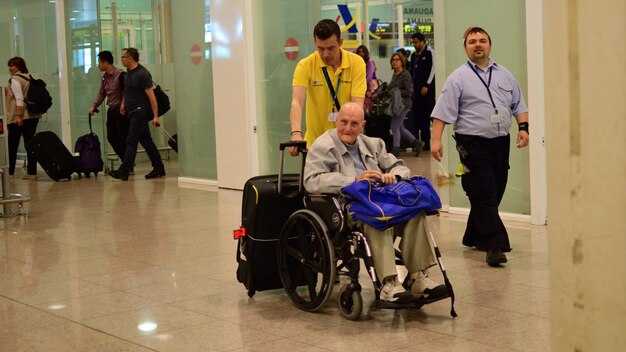
At check-in, tell the desk agent you have a wheelchair request on file and confirm how you'll be escorted to security and the gate. On arrival at JFK, an airline wheelchair attendant meets you at the gate or jet bridge and can take you through baggage claim to ground transportation. If you don't see anyone and you're on the jet bridge or at the gate, ask any airline staff member to radio for assistance rather than trying to track someone down yourself.
TSA Cares: help at the security checkpoint
TSA Cares is a separate program that helps travelers with disabilities and medical conditions navigate the security screening process — it does not provide a wheelchair itself, and it has no role in getting you to or from the checkpoint. Call (855) 787-2227 at least 72 hours before you fly (Monday–Friday 8 AM–11 PM ET, weekends and holidays 9 AM–8 PM ET), or submit the online TSA Cares request form, to arrange a Passenger Support Specialist (PSS) — a TSA officer trained to assist and communicate with travelers who have disabilities. A PSS can walk you through what screening will involve, coordinate a private screening area, and reduce wait time at the checkpoint. Motorized wheelchairs and scooters are welcome throughout JFK's terminals; check with your airline in advance whether the device needs to be checked as baggage or can stay with you to the gate.
At JFK itself: Port Authority support
Beyond your airline and TSA, the Port Authority of NY & NJ staffs JFK with Airport Customer Experience Specialists (ACES) — identifiable by red uniforms, based at Information Centers in each terminal — who can help with directions, general questions and on-the-spot problem-solving anywhere in the airport. Reach the team at +1 (718) 244-3563 (Monday–Friday, 9 AM–5 PM ET), by WhatsApp, or by video call (Monday–Friday, 8 AM–11:59 PM ET). This is a useful backup line if an airline wheelchair attendant hasn't shown up, or if you simply need help finding an accessible restroom, a service animal relief area, or the way to Federal Circle for a rental car.
Your rights under federal law
The Air Carrier Access Act, enforced by the U.S. Department of Transportation, prohibits airlines from discriminating against passengers on the basis of disability and sets minimum standards for the assistance described above. A December 2024 DOT final rule strengthened these protections further: mishandling or damaging a passenger's wheelchair is now treated as an automatic violation of the ACAA, airlines must return wheelchairs promptly and in the condition they were received, and ground crews require enhanced training on safe handling. Separately, new DOT performance standards for aircraft on-board wheelchairs (narrower chairs used to move between an airline seat and the lavatory) take effect October 2, 2026, covering seat width, footrest adjustability and maneuverability in tight aisles.
If something goes wrong — a wheelchair is damaged, assistance doesn't show up, or you're treated in a way that breaches these rules — first raise it with the airline's on-site Complaint Resolution Official (CRO), a role every U.S. carrier is required to make available at the airport. If the airline doesn't resolve it, the DOT Disability Hotline at 1-800-778-4838 (Monday–Friday, 9 AM–5 PM ET) provides real-time help with time-sensitive disability-related issues and can guide you through filing a formal complaint.
Accessible facilities at JFK
- Restrooms and water fountains across all terminals are accessible.
- Service Animal Relief Areas (SARAs) are available at every terminal, with both indoor and outdoor spaces featuring artificial grass, a sink and waste stations.
- Accessible parking is available in every JFK parking facility, including near terminal entrances and in the long-term lots by the Howard Beach and Lefferts Boulevard AirTrain stations. A vehicle must display a valid, non-expired ADA placard, disabled plates or a state-issued permit; short-term garage spaces for placard holders are billed at a reduced rate of $35 per 24 hours, and no prebooking is required.
- Motorized wheelchairs and scooters may be used throughout every terminal, airside and landside.
- The Port Authority also runs dedicated support pages for vision, hearing and non-visible disabilities, alongside a remote ASL interpreting pilot for Deaf and hard-of-hearing travelers — ask an ACES team member on-site for the current details, since these programs are expanded periodically.
Traveling with a service animal
Airlines set their own documentation and seating policies for service animals under the ACAA, so confirm requirements with your specific carrier before you fly. At JFK itself, every terminal has a Service Animal Relief Area you can use both before and after security — ask an ACES team member or airline staff for the nearest one if you can't find the signage.
Tips for a smoother trip
- Request wheelchair assistance when you book, not just at check-in — it's not legally required, but it gives ground staff time to plan for your flight.
- Call TSA Cares 72 hours ahead if you want a Passenger Support Specialist or expect the screening process to be difficult.
- Give power wheelchairs 48 hours' notice so the airline can arrange safe battery handling.
- Save the ACES contact number (+1 718-244-3563) in case an airline escort doesn't show up on arrival.
- Photograph your own wheelchair before it's gate-checked, so you have a clear record if it comes back damaged.
- Know the escalation path: airline gate/ground staff first, then the airline's Complaint Resolution Official, then the DOT Disability Hotline if it's still unresolved.
Frequently asked questions
Who provides wheelchair assistance at JFK — the airport or the airline?
Your airline. Under the Air Carrier Access Act, the airline is responsible for wheelchair service from check-in through the gate and to baggage claim or your connection, not the airport or TSA.
How far in advance do I need to request wheelchair assistance?
Airlines cannot legally require advance notice for a standard wheelchair request, but request it at booking and reconfirm at check-in. If you're bringing your own power wheelchair, airlines can require up to 48 hours' notice.
What does TSA Cares actually do?
TSA Cares helps you through the security screening process by arranging a Passenger Support Specialist. It does not provide a wheelchair or escort you to the checkpoint — that's still the airline's job. Call (855) 787-2227 at least 72 hours before you fly.
Can I use my own motorized wheelchair or scooter inside JFK?
Yes, throughout every terminal. Check with your airline in advance whether it needs to be checked as baggage at the gate or can stay with you.
What happens if my wheelchair is damaged by the airline?
Since a December 2024 DOT rule, mishandling or damaging a passenger's wheelchair is treated as an automatic violation of federal law, and airlines must return it promptly in the condition received. Report it immediately to the airline's Complaint Resolution Official at the airport, and escalate to the DOT Disability Hotline (1-800-778-4838) if it's not resolved.
Are there accessible parking spaces at JFK?
Yes, in every parking facility, including near terminal entrances. A valid ADA placard, disabled plates or state permit is required; placard holders get a reduced short-term garage rate of $35 per 24 hours with no prebooking needed.
Who do I contact if my airline wheelchair escort doesn't show up?
Ask any nearby airline staff to radio for assistance first. As a backup, JFK's Port Authority Airport Customer Experience Specialists can help on the ground at +1 (718) 244-3563.
Sources
- TSA Cares program, request form and Passenger Support Specialists — Transportation Security Administration: tsa.gov
- Air Carrier Access Act and traveler rights — U.S. Department of Transportation: transportation.gov
- 2024 DOT final rule on wheelchair damage and airline accountability — Federal Register: federalregister.gov
- JFK accessibility services, ACES contact and mobility information — JFK Airport (Port Authority of NY & NJ): jfkairport.com
This guide is general information for travelers, current as of 2026, and is not legal advice. Airline policies, contact details and DOT rules can change — always confirm current requirements with your airline, TSA Cares and JFK's official accessibility pages before you travel.